

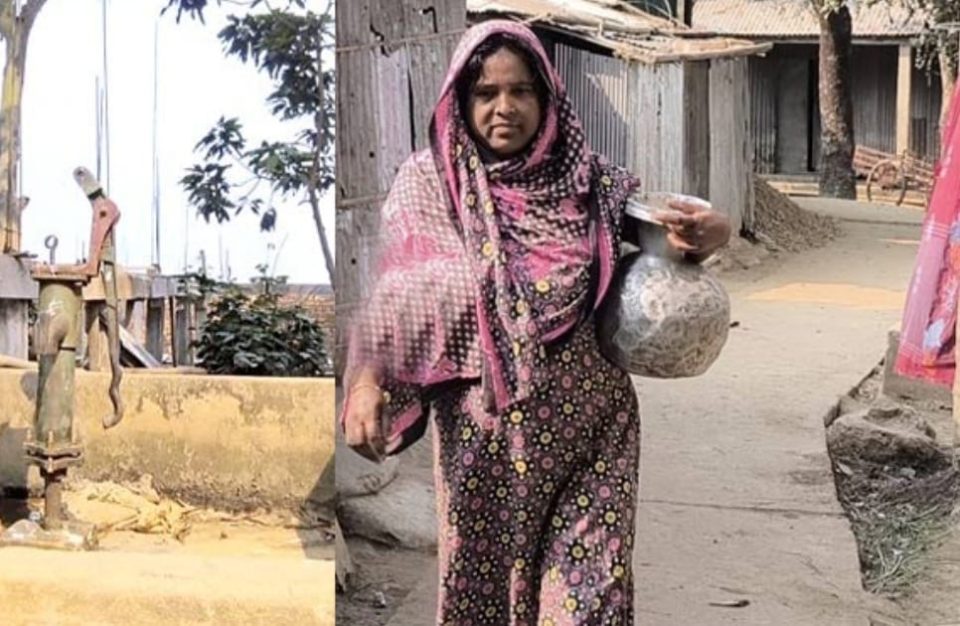
A.F.M. Asad Ullah: Sunamganj is facing a severe water crisis due to heatwaves, lack of rainfall, and the filling up of rivers, canals, and wetlands. The groundwater level has significantly dropped, leaving shallow tube wells dry and sparking a desperate search for water across the district.
In Shimulbak village of Shantiganj upazila, Jharna Begum was seen heading out with a pitcher in search of drinking water. She must travel several kilometers to fetch a single pitcher of water for her family.
Jharna Begum said, “The water we drink often makes us sick. That’s why I go far to fetch water. I don’t know when this suffering will end.”
According to sources, a special project worth 340 million BDT was initiated in 2019-20 under former Planning Minister M.A. Mannan to provide safe water to rural areas in Shantiganj-Jagannathpur constituencies. Under this project, 3,300 tube wells were installed in Shantiganj at a cost of 205 million BDT, and 2,500 tube wells in Jagannathpur at a cost of 135 million BDT. However, within two years, most of these tube wells have become non-functional. The operational ones produce only a trickle of water.
Residents of Shimulbak village, Halal Mia, Sabab Mia, and Ekhlas Mia, alleged, “There was massive corruption and irregularities in the tube well project initiated by former Planning Minister M.A. Mannan. Most of the tube wells in the two upazilas are now useless.”
This problem is not limited to Shantiganj and Jagannathpur but extends across 12 upazilas, including Sadar, Bishwambharpur, and Dowarabazar. Shallow tube wells, both government and privately installed, are facing the same fate. For pure water, people rely on deep tube wells, which are unaffordable for low-income families, prompting calls for government assistance.
Sadar upazila resident Sabana Begum shared, “As soon as the dry season begins, tube wells stop producing water. We are forced to boil water from ponds and rivers for drinking, which causes various waterborne diseases.”
Dowarabazar resident Kobori Begum said, “We have to endure hardship and go to other people’s homes for a drop of tube well water, but often we return empty-handed. We want relief from this suffering.”
Maizbari resident Rakiba Banu added, “My children are falling ill from drinking river water. We demand an end to this water crisis.”
According to the District Public Health Engineering Department, there are 23,565 operational government-installed shallow tube wells in the 12 upazilas, alongside over 100,000 privately installed ones. However, nearly 10,000 tube wells have become inoperative due to the declining water table during the dry season.
Executive Engineer of the Public Health Engineering Department Syed Khaledul Islam stated that to address the water crisis, the installation of 5,000 submersible pumps has begun in 12 upazilas, with completion expected by December 25. He assured that the water crisis would be resolved once the project is finished.

