

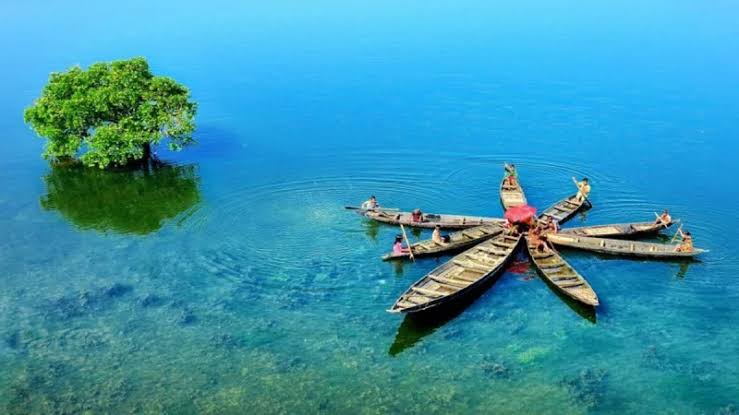
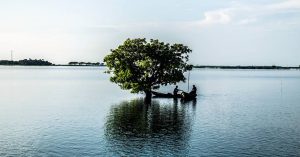
Emdad Hossain Bhuiyan, Sylhet: The water of Tanguar Haor in Sunamganj sparkles with a blue glow when the sun shines. Locals say that this water could one day reach beyond the country’s borders to the desert-dominated Middle East or African countries facing an acute shortage of fresh water.
While the world is grappling with an acute water crisis, the vast water resources of Bangladesh’s rivers, canals, canals, haors and reservoirs are writing a story of new economic potential. Experts say that with the right planning and technology, this water resource can become Bangladesh’s new power—‘Blue Gold’.
Water crisis in the world, abundance in Bangladesh
Data from the World Health Organization and the United Nations say that by 2050, 40 percent of the world’s people will face extreme water shortages. Currently, about 2.2 billion people are suffering from a lack of safe water. At such a time, Bangladesh’s average rainfall of 2300 millimeters, more than 700 rivers and numerous haors and basins have made the country stand in an exceptional geo-natural reality.
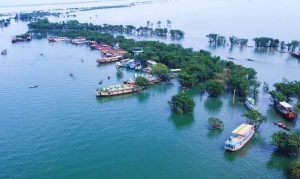
The pH and TDS levels of the water in the Sunamganj, Netrokona and Sylhet regions are naturally suitable for international standard bottled water. The water of Tanguar Haor in particular is so pure that experts call it a “gold mine” for Bangladesh.
New prospects in the global market
The bottled water market is expanding rapidly. In 2024, the size of this market stood at 345 billion US dollars. According to forecasts, it will reach 525 billion dollars by 2030.
If Bangladesh can capture even 1 percent of this market, an estimated export income of 3.5 billion dollars is possible annually. Not only that, but new horizons for employment of thousands of people and foreign investment will also be opened.
Outline of water export: What to do now?
1. Rainwater conservation: Construction of eco-friendly reservoirs and dams, construction of drainage and overflow canals in haor areas.
2. Modern treatment plants: Use of international standard purification technology and UV filters; Water industrial zones in public-private partnerships.
3. Export-oriented infrastructure: Bottled water processing zones, duty-free and duty-free facilities.
4. Quality and certification: WTO-approved quality control organization, digital tracing system.
5. Branding: ‘Bangladesh Pure Water’—entering the global market as a halal and eco-friendly brand.
World models, opportunities for Bangladesh
Singapore’s Newwater technology, Saudi Arabia’s halal water brand, France’s Evian, or India’s Himalayan brand—all prove that it is possible to lead the water economy with strategic planning and technology.
These models can be implemented more cost-effectively by utilizing Bangladesh’s geographical advantages, abundant water resources, and affordable labor costs.
The journey of ‘Blue Gold’ begins here
Bangladesh now has a historic opportunity. In this time of climate crisis, the global demand for clean water will only increase. With the right planning, investment and diplomatic initiatives, Bangladesh can become the center of the world’s water economy in the near future.
In the words of experts—“Bangladesh’s water is now not only going to be the driving force of life, but also of the economy.

