

A F M Asad Ullah Asad: From morning till evening, the farmers and their families in the haor regions have no leisure time. On one side, paddy harvesting is in full swing, and on the other, threshing, boiling, and drying of the paddy are ongoing. Amid such activities, the farmers along the haor banks of Moulvibazar are spending busy days.
Recently, in areas like Baneshree, Raipur, Jumapur, and Kadipur near Kawadighi Haor, wherever one looks, one can see the grand festival of boro paddy harvesting. Along with it, the aroma of boiled paddy fills the air.
In conversations, locals shared that several temporary paddy threshing yards have been set up in the haor areas. Farmers cut paddy from their fields and bring it to their designated yards. Here, the paddy is threshed, boiled, dried, and turned into rice before being taken to their homes.
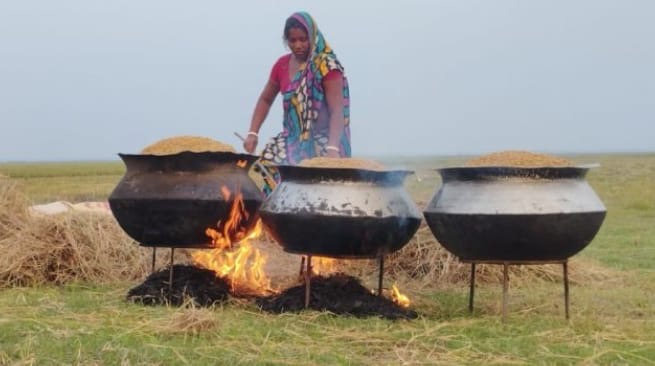
At one such paddy threshing yard in Kadipur, a middle-aged woman, Sumati Dash, was found busy boiling paddy. She had arranged paddy in three large pots, carefully pouring measured amounts of water for soaking before boiling them.
While talking, she reminisced, “Once upon a time, our mothers and grandmothers boiled paddy in large clay pots. Now, we boil paddy in silver pots on temporary iron stoves. These stoves are specially prepared with iron rods in the evening. Straw is used as fuel. Each pot can boil 40 to 42 kilograms of paddy, and it takes about an hour to boil one pot.”
She explained further, “After boiling the paddy, it is spread on mats made of plastic sheets, bamboo trays, or specially made earthen threshing yards for drying. Depending on the sunlight, it takes 2-3 days for the paddy to dry. Light rain can create problems in drying, but the stronger the sunlight, the better it is for the paddy.”
Another farmer from Kadipur village, Binita Rani Sarkar, shared, “We remain busy throughout the day. The men leave for the fields early in the morning, and we women, after finishing cooking at home, take care of drying the paddy, drying the straw, and boiling the paddy. Often, we continue working till late at night, only to start the same routine the next morning. However, when the boiled paddy is finally turned into rice, all our exhaustion is forgotten, and our hearts fill with joy.”
Even though the farmers spend busy days from morning till evening, their faces show no signs of despair. Why would they feel disheartened? This busy schedule represents their dreams of a better future. When the harvest is good, it brings smiles to the farmers’ faces. And when they can successfully bring the harvest home, their efforts feel worthwhile.

