

Md. Amdad Hossain Bhuiyan
The historic Bashia River, flowing through Bishwanath municipality, is on the verge of extinction due to encroachment and pollution. Local residents have been dumping garbage into the river year-round, filling it up indiscriminately. Additionally, many have built shops, marketplaces, hotels, restaurants, and residential houses either by force or by managing the concerned authorities. Once a vibrant and fast-flowing river, Bashia is now virtually nonexistent over time.
Although locals have been voicing concerns about encroachment and pollution for a long time, no visible results have been achieved. Movements to save the river have been ongoing for more than a decade. Despite increasing encroachment, neither the upazila administration nor the municipal authorities have been able to take effective measures. Whenever the issue gains attention, they merely undertake superficial actions to fulfill formalities.
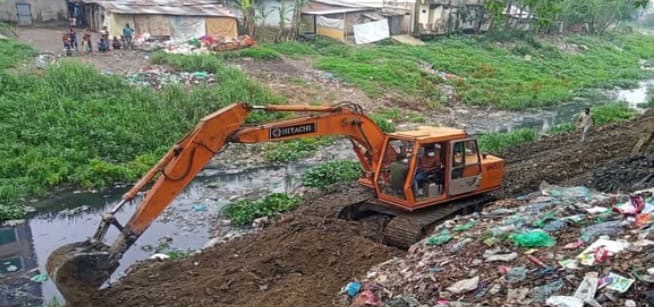
On Saturday at 11 a.m., Municipal Administrator Sunanda Roy formally inaugurated a five-day garbage removal program organized by Bishwanath Municipality with the overall assistance of Sylhet City Corporation. It has been reported that a budget of 5 to 6 lakh taka has been allocated to clean up the garbage from the Upazila Court Point to the New Market TNT Road area. The waste is supposed to be transported to Sylhet City Corporation’s dumping station afterward.
It is worth noting that this river, approximately 56 kilometers long and 200 meters wide, used to facilitate boat, large launch, and steamer movement. However, during the dry season, it now barely holds any water, effectively turning into a dying canal.
The Bashia River originates near Masukganj Bazar on the banks of the Surma River, located in Sylhet’s Jalalabad police station area. It connects South Surma, Bishwanath, Osmaninagar, and Jagannathpur upazilas before merging with the Kushiyara River at Raniganj’s Shadhin Bazar. Bashia River once played a crucial role as the only drainage channel for these five upazilas. However, in recent years, the river’s source has been blocked, and its banks have been encroached upon and filled in various areas. As a result, water from the Surma River can no longer flow into the Bashia River, disrupting its natural drainage process and leaving it nearly dry.


